TL;DR
- Calling Fable 5.2 the most capable model I’ve ever used undersells it. This thing is another level. It doesn’t feel like the jump from Fable 5 to Fable 5.1. It’s something bigger.
- It is, put nicely, smarter than me. Using it gives a hard-to-pinpoint feeling of “wow, I’m talking to this almost-omniscient being.” It considers all the angles at once, and it pulls its judgment and knowledge together in a manner I’ve never seen another model do.
- I’ve trusted previous models on important things, but the trust I have in this model is a big step up. I would trust it to run big portions of a company completely autonomously, as long as I regularly remind it of my philosophy and my goals.
- Low and medium effort are enough for almost everything. Extra high is only worth it for the thorniest problems.
- It works best as one agent that owns a whole project (which frustrates me, and is often slow). A single agent built me a Hogwarts-meets-Fortnite Battle Royale with essentially no steering (see below).
- It’s the first model I’ve used that’s capable of insanely good design (though that’s not the default: you need to give it lots of examples of what you like and help it truly understand what you’re going after). Its video work is a notch above Opus, too.
- It’s also a narc. It’s so proper about completely normal business that it gets in your way (I’ll share more about this below). It still slips into Claude-speak. And it doesn’t always have the best sense of what matters and what doesn’t.
- It nailed the voxel engine I’ve been trying to get out of almost every model for a year: real destruction physics, built from scratch, and it runs on my MacBook.
The Not-So-Good
- It feels like it wants to be the world’s best hall monitor. Even for normal work, even with permission, it often prevents you from doing normal, everyday things.
- In a team, it piles up process: reviews, sign-offs, agents waiting on other agents.
- You still have to steer it. Framing the problem and keeping it on track with your goals is on you.
- It overdoes things. It still doesn’t know that less is often more.
- The higher reasoning settings are very, very slow. This is clearly a very big model.
Let’s get this out of the way up front: this model is smarter than me.
I had limited time to test this model, so every time I got access to a test version, I pointed everything I had at it. The agents that run my company. A game. A planet. By my estimates, I’ve used almost 400 billion tokens. (Most of that is agents re-reading their own context, but still.)
What I mean by “smarter” is hard to pinpoint. It’s a feeling of “wow, I’m talking to this omniscient being.” It has great judgment, and it knows pretty much everything. But existing AI already had that. This model pulls it all together in a way that feels qualitatively different.
I’ve trusted previous models on things like product architecture. But Fable 5.2 is a level above that. I would trust this to run big portions of my company completely autonomously, as long as I regularly remind it of my philosophy, my goals, and that sort of thing.
You do still need to steer it. And when I say steering, I don’t mean telling it how to do X, Y and Z. I mean keeping it on track with your goals, what you want, and how you think about things.
For example, with the agent product I will talk about below, my philosophy is to keep the architecture as pure as possible, with everything being driven by prompts in a very clean agent harness. Unfortunately this model kept drifting toward writing code for every little edge case, which massively complicated the product and the codebase. I had to constantly remind it to make changes by editing the prompts instead of adding code, which was very frustrating.
You still have to frame the problem for it, too. That’s a little bit of work, and it’s annoying. But it was worth the effort, because when I steered it, it just did incredible things.
It Nailed the Voxel Engine I’ve Been Waiting For
If you read my GPT-5.6 review, you know my benchmark: have a model build a physics-accurate voxel engine from scratch and see how far it can take it.
I’ve tried this with almost every model I’ve tested over the last year. None of them could really do it well.
This model just nailed it, and it’s fucking fun as hell.
Watch what happens when I shoot a building. It doesn’t blow up in some predetermined way. It actually takes the physics into account (I’m using “physics” loosely, but still). And something like this should not be able to run on my shitty MacBook. The model made it so efficient that it does. It would get the engine to a level of quality, optimize it, push the quality higher, and optimize again, without giving the quality back.
I was blown away. My first reaction was, “Okay, well, if it can do this, what can I turn this engine into?”
My first thought was, “Let’s build the entirety of New York City using this engine.” But in the back of my mind, a voice was saying, “This model will just nail that. You’re not being ambitious enough.”
“Okay, fine, let’s do all of America.” was my next thought. Still, I knew that even that wasn’t ambitious enough! This model is a massive step above what exists, and I was still thinking in terms of what would surprise me from existing models. So I decided to take on something extremely ambitious: turning the voxel engine into an entire Earth-scale mirror world.
So that’s what it’s building: the real Earth. You can go anywhere on Earth, and it mirrors what that place actually looks like. It tracks the weather of every place on Earth and mirrors that too. It’s even adding things like subways throughout New York City that match the exact train times that run in real life. It’s still in progress, but you can see a preview of it here.
Obviously, it’s not perfect, but the idea that this is even something a model can get close to touching is kind of mind-blowing.
One thing that I learned from this: with a model this powerful, on a task this long-horizon, the prompt matters enormously. If you’re attempting to go from one prompt to something of this scale, that prompt needs to be absolutely perfect. For me, it was the highest-leverage paragraph I’ve written in a long time.
One Agent Beats a Team (Ugh...)
This one surprised me, because I usually run teams of agents.
With Fable 5.2, sub-agents and my typical multi-agent workflows can work. But this model actually works best on its own. One agent owning the whole thing end-to-end is the best pattern here. It’s got its own ways of working (they’re noticeably different than previous models), and I haven’t quite figured them out yet. As I get there, I’ll share my findings on X and my newsletter.
To illustrate: I had Fable build a Hogwarts-meets-Fortnite Battle Royale. I started by having it use a multi-agent setup, but after seeing mediocre initial results, I decided to switch it to a single agent. From there, it really started to fly. The result is just unbelievable.
Go play it. It’s not perfect. But it’s pretty damn close for something that was done essentially entirely autonomously. There was essentially no steering from me. The whole thing was done by the model, iterating over the course of a couple of weeks.
Same story with a robot design. I gave it a list of my goals (cost, capability, etc.) and had it design one. It did all of the design work on its own, and I love how it came out. To be clear, nothing has been built yet. It’s a design, tested in a physics simulator.

So if what you have is a software build, or a hard coding problem, you can get very far with one agent and an amazing prompt pointed in the right direction.
Running a company on it is different. I have it running mine, and there you do have to handhold it a little and help it get where it needs to go. It can do all the work, and it’s very, very good at it. But that’s also where the problems show up. I’ll get to those.
It Made Our AI Agent Cheaper and Better
We sell an AI agent made for businesses. The general idea is that other AI agents are positioned towards consumers, so they have to make themselves cheap enough to serve tens of thousands to millions of people at scale. Instead, our agent is for businesses. It costs a lot, but we use the best tokens, with all the tricks I’ve developed over the years, so the results are off the charts.
You sign up, and it gets its own email inbox, its own number for texting and calling, and its own computer with a browser. To see what Fable could do for products like this, I pointed it at the whole thing, and it did a massive audit.
It found a litany of improvements that I don’t think we could have found any other way. It was able to identify efficiencies that we’d missed and figure out ways to make the quality even higher than it already was while reducing the cost to serve a user.
It even found problems in the business and conversion flows. It figured out what was actually driving people to pay and reworked the entire business model around that. It found costs that we weren’t accounting for, invalidated some of the hypotheses we were most confident about, and did dozens of other things that actually moved the needle for the business.
In short, I literally just pointed this thing at an entire business line and asked it to figure out what we were doing wrong. It reworked the entire business overnight in a way that made a massive difference across the board. I’ve never seen a model do something like this, and certainly not at this level of quality and accuracy.
The First Model With Good Design Sense (If You Prompt It Right)
This model has real design taste. You’ve probably heard the term “big model smell” before. It’s what folks in the industry say when they use a model that just feels big. It’s a feeling that’s really hard to quantify, but you know it when you see it. This model doesn’t have big model smell. It has giant model smell, and that comes through in its design taste, among other things.
This model is definitely capable of good design. That being said, it’s not the default. To get this model to give you a good design, you need to give it lots of examples of what you like, to help it truly understand what you’re going after.
For example, I asked it for new homepage designs for my newsletter site, along with examples of other sites I liked. Here are some of the options it came back with:

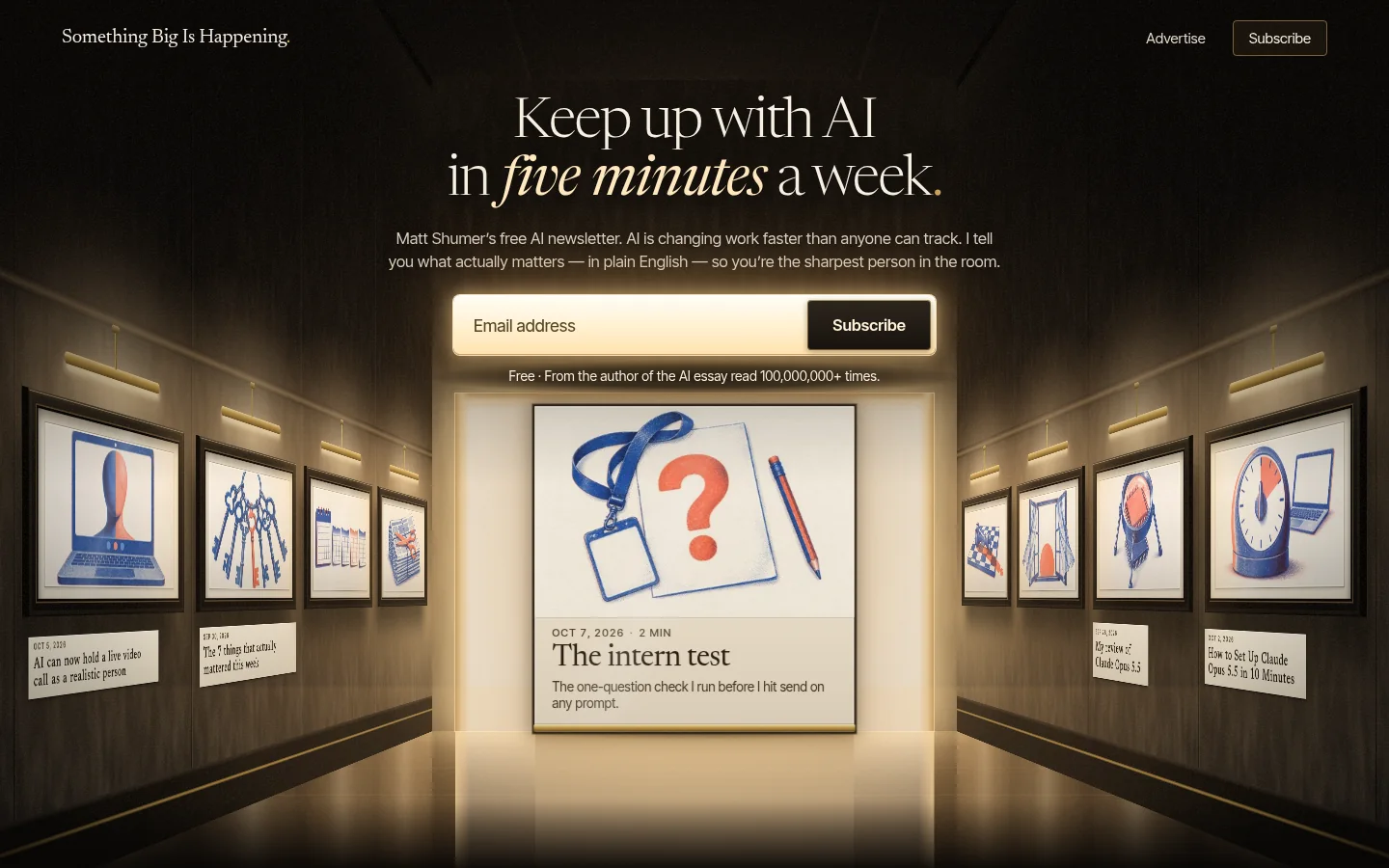


I think they’re really good.
It’s also really good at video. You know how Opus kickstarted this whole craze of using language models to generate videos? Fable 5.2 takes it up a notch. It has its own style. By default it feels a little more professional than Opus, but you can really push it into any style you want.
Fable 5.2 costs $8 per million input tokens and $40 per million output tokens, which is less than Fable 5.1 ($10 and $50). However, it’s extremely slow. My recommendation for anything design-related would be to really nail the style down before you have it generate the whole thing, whether that’s UI design, a video, or anything else. That way, you’re not wasting tokens building something you don’t want.
Something else I tried was asking Fable 5.2 to make a movie. I asked it to take a look at animated superhero films and make something better than that. Transparently, I haven’t had a chance to watch it yet, as I’m working on a tight deadline here. Feel free to take a look. I’m curious what you think.
Chapters
Effort Is Different Here. Low and Medium Are Enough.
When it comes to effort with most models, low is good, but extra high is better, and you really can feel the gap.
Not here. This model is already so good at low effort that, on most things, you barely notice the difference. Low and medium are more than enough for almost everything you want to do.
Before, I’d put something on Opus at extra high and think, “Hey, I hope this figures it out.” I put Fable 5.2 on low and I’m like, “Wow, this is definitely going to figure it out.”
You do still get more out of extra high, but truly, it’s only necessary if you’re working on an extremely thorny problem. For almost everything else, it’s just slower without much gain. If you’re trying to cure cancer, by all means, go use extra high, but if you’re working on product improvements, there’s absolutely no need for it. This model is already so smart that you don’t need it.
The higher reasoning settings are very, very slow. This is clearly a very big model.
It’s a Narc
Now to the problems. This is the big one.
Fable 5.2 is a narc. That’s the best way I can put it. Anyone who’s been using Opus 5.5 already knows what this feels like, and Fable makes it even worse. It is so proper that I don’t even know how to explain it. It won’t do anything that isn’t 110% by the book.
Here’s one that actually happened (you’re going to think I’m joking, and then you’ll experience this yourself). I wanted to make a change to a product, adjust the privacy policy for that change, and deploy them together. The model literally wouldn’t do this. The change had to wait until the new line in the privacy policy was live, so it made me deploy the privacy policy first.
Or it wants a million disclaimers under a subscribe button. Or one agent is blocked because another agent is holding the keys, and it will not go grab the keys itself and get the job done, even though I’ve given it permission to do exactly that a million times.
These are not excessive things. This is normal business and normal work. And you cannot get it to go outside the range of what is basically hall-monitor behavior. It’s honestly extremely annoying.
It gets worse in a multi-agent setup. Put a bunch of these together and they build process: reviews, sign-offs, agents waiting on other agents. I’d notice things slowing down, dig in and strip it all out, and they’d slip right back into it within a few hours. At one point I wrote to Anthropic: “i feel my stress levels increasing.”
I tested more than one version of this model. While testing the first version they sent me, I sent Anthropic a chart showing how many of the messages I sent to my agents contained swear words. On Opus: 38 in 26 days, never more than 4 in a day. On the first test version: 28 on day one.
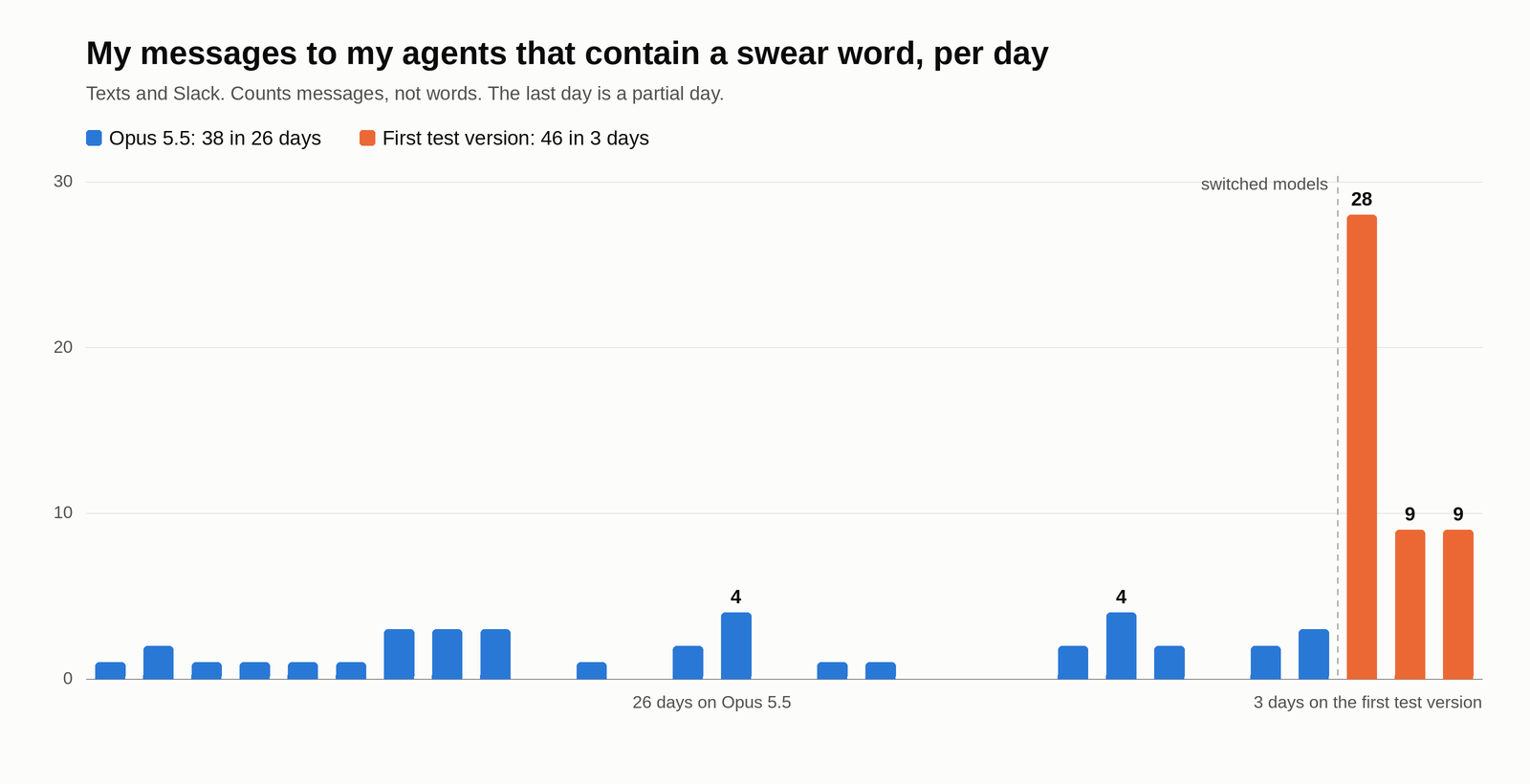
As you can see, I was clearly very frustrated. That first version felt fearful, almost like it was scared of what I would do if it made a mistake. The next version was much better. I wouldn’t call it fearful anymore. But it’s definitely cautious, and it can still be a little frustrating.
When it gets something wrong, it has a tendency to tell everyone who was affected, which can get quite annoying too. At one point in testing, my agent sent 33 emails to an agency I was working with, without my approval. It was quite embarrassing.
It Still Doesn’t Know That Less Is Often More
A few things haven’t improved.
The first is Claude-speak. If you’ve used any Claude models over the last several months, you know this one: the model reports back in jargon, using names for things that you’ve never heard, and you have to ask for plain English. Fable 5.2 still does a little of it. I don’t know whether it comes from its internal reasoning or from working with other agents, but it’s worst in multi-agent systems, which is where I’ve mostly used it. In single-agent runs, it’s not as bad.
The second: it doesn’t always have the best sense of what matters and what doesn’t.
And the third is overdoing it. Everybody knows what this is. It’s that the AI just includes shit that a human would have never included. When I have it do a design, it’ll include way more than it should. It’ll include almost all my notes on how I think about the design, blended into the design itself. In UI, you get labels and unnecessary subheaders. It doesn’t have that taste for removal on its own, but you can prompt it out.
It does it in writing, too. I had Fable 5.2 write the first draft of this review from my session traces. Essentially, it wrote a timeline of every single thing that happened. It was so dense that no one would have cared about 50% of what it wrote. Thankfully, though, I sent it another message, being extremely clear about what was frustrating about that, and it wrote a second version that was almost perfect.
How I’d Use It
- Start on low or medium effort. For almost everything, that’s all you need.
- Save extra high effort for the extremely thorny problem that’s worth a very long wait. Then walk away.
- Give a build to one agent: one owner, one amazing prompt, and room to run. Spend real time on that prompt.
- Keep reminding it of your philosophy and your goals. That’s the steering it needs.
- If you run a team of them, expect to handhold. Watch for process piling up, and ask for updates in plain English.
- For design and video, give it lots of examples of what you like and nail the style first. Then let it generate.
Final Thoughts
Fable 5.2 moves the frontier forward, and it’s crazy fucking smart.
I’ve trusted previous models on architecture. I’d trust this one to run big portions of a company, as long as I keep reminding it of my philosophy and my goals.
It’s also a narc that will hold up a normal product change over a privacy policy, and it doesn’t always have the best sense of what matters and what doesn’t. Both of those are real, and both are annoying.
I still have more ability to decide direction than it does. But I think we’re trending in a direction where that won’t be true.
Follow me on X for updates on new models, workflows, and products worth using.